







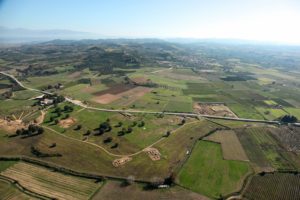


Elis, an ancient city-state on the left bank of the Pineios River, extended between the mountainous Akroreia and the coastal Koile Elis. Human presence in the area dates from the Middle Paleolithic period (c. 130,000–120,000 BC) to the Early Byzantine period (7th century AD). According to myth, its founder was the Aetolian Oxylus (12th–11th century BC), while the city experienced periods of prosperity during the “Dark Ages” (11th–10th century BC), the early Classical period (6th–5th century BC), and the Roman era (2nd century BC–3rd century AD).
Settlement in the area included Neolithic habitation sites, Mycenaean villages and tombs, as well as small communities during the early historical periods. Development was strengthened by the establishment of a democratic constitution and the synoecism of 471 BC. The city experienced wars and conquests by Spartans, Macedonians, and Romans, was incorporated into the Roman province of Achaea, and retained an important role due to its responsibility for organizing the Olympic Games.
Elis suffered destruction from invasions and earthquakes between 267 and the 6th century AD and was definitively abandoned in the 7th century AD. Notable figures originating from Elis include Iphitos (organizer of the Olympic Games), the sophist Hippias, and the philosopher Pyrrho.
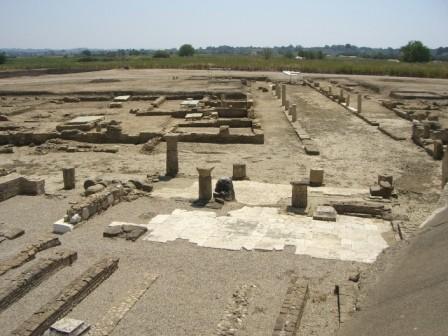
Excavations began in 1910 by the Austrian Archaeological Institute and continued in 1960 by the Archaeological Society of Athens. The archaeological site includes the agora, the theatre, residential areas, cemeteries, the acropolis, and gymnasia, while suburbs and smaller settlements developed around the city. The agora preserved its original character, while older houses were destroyed or reused as building material for later constructions.
The most important monuments include the theatre with its earthen cavea and stage building, stoas, the bouleuterion, and gymnasia. At the southern edge are sanctuaries, altars, and monumental buildings, possibly dedicated to the worship of Roman emperors. Cemeteries and suburbs extend along the main road axis, while the acropolis dominates a hill to the east of the city.
Elis represents a characteristic example of a city that was abandoned after antiquity, preserving significant remains of both Greek and Roman civilization.
ΠΗΓΗ: http://odysseus.culture.gr/ Συντάκτης Χρήστος Ματζάνας, αρχαιολόγος
https://ilia-olympia.org

