






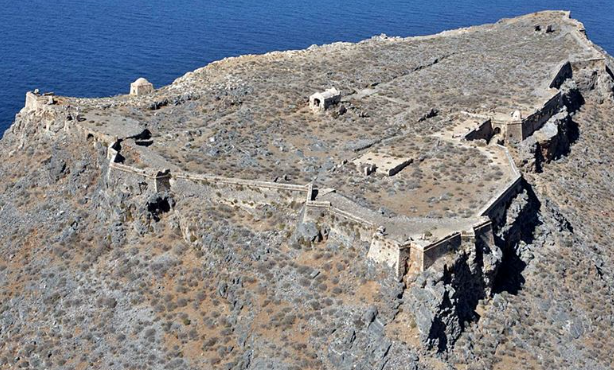
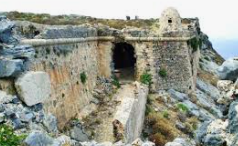


The northwestern tip of Crete is occupied by the Gramvousa peninsula, near which lie the small islands of “Imeri” (Calm) Gramvousa and “Agria” (Wild) Gramvousa. Between these islands, a fairly safe harbour is formed, the first one encountered by ships arriving from the west. Due to this strategic position, the Venetians decided to build a fortress there as part of their broader efforts to strengthen the island’s defenses in Crete. The first to propose the fortification of the islet to the Venetians was Sofianos Eudaimonogiannis, a Greek military officer in Venetian service. The construction of the fortress on the summit of the steep rock on the western side of the islet began in 1579, based on designs by the engineer Latino Orsini. The fortress followed the natural terrain, reinforcing its weaker points with bastions while leaving the steepest sides unfortified. It has a triangular shape and included all necessary facilities such as barracks, storage rooms, churches, wells, and water cisterns. After the Ottoman conquest of Crete in 1669, the fortress remained under Venetian control, as did the fortified islets of Souda and Spinalonga. However, its commander Luca Della Rocca eventually surrendered it to the Ottomans in 1692, after it had already been abandoned by the Venetians and had lost any significant strategic role. In the following years, the fortress saw only limited use. During the Greek Revolution of 1821, it was temporarily captured by revolutionaries and served as a base for raids and acts of piracy.
http://odysseus.culture.gr/ Συντάκτης Τσίγκου Αγγελική-Εφορεία Αρχαιοτήτων Χανίων
https://www.kastra.eu/

