







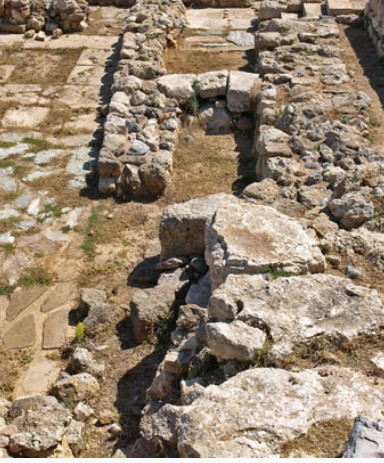


Human occupation at Palaiochora (Amnisos) began during the Middle Minoan period (19th century BC). The name of the site appears as a-mi-mi-so in the Linear B tablets, written in the Greek language. The Villa of the Lilies was destroyed by fire in the 15th century BC, while Complexes C and E continued to be inhabited until the 12th century BC. In the 7th century BC, during the Archaic period, the Sanctuary of Zeus Thenatas was founded and remained in use until the 2nd century AD. The hill was reoccupied during the Venetian period.
Among the most important monuments and architectural complexes is the Villa of the Lilies, a Minoan residence featuring paved corridors, polythyra (multiple-door partitions), a shrine, a kitchen, and rooms decorated with frescoes depicting blooming lilies. The Sanctuary of Zeus Thenatas, located on Palaiochora Hill, consists of an enclosure with a circular fire altar. Today, a wall built of carefully dressed ashlar blocks dating to the Middle Minoan II period can still be seen next to the sanctuary. Another significant structure is Building C, or the Megaron, a Minoan building divided by a wall into two independent rooms and used until the 14th century BC. West of the hill lies Complex E, part of a Late Minoan settlement, a portion of which has sunk beneath the sea. The complex is divided into two large wings: an eastern wing containing storage rooms and a western wing that includes a shrine and a votive deposit area. Complex F, also known as the Mycenaean settlement, may have been a continuation of Complex E. It consists of irregular building clusters with storage space for amphorae, a possible small shrine, and an open courtyard. Finally, remains of Venetian-period houses survive on the hill, belonging to the settlement of Mesovouni, which was destroyed during the early years of Ottoman rule.
http://odysseus.culture.gr/

