






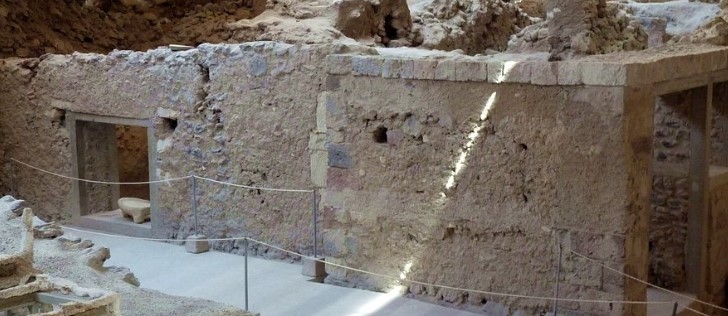



Akrotiri was one of the most important centres and ports of the Aegean during prehistoric times. Occupation began as early as the Late Neolithic period, and the settlement developed particularly during the Bronze Age. Its large extent, excellent urban planning, drainage system, multi-storey buildings, wall paintings and rich furnishings testify to the settlement’s high level of development and prosperity. The imported products demonstrate Akrotiri’s extensive commercial and cultural relations with Minoan Crete, mainland Greece, the Dodecanese, Cyprus, Syria and Egypt. Life at Akrotiri came to an abrupt end in the last quarter of the 17th century BC, when the inhabitants abandoned the city because of powerful earthquakes. The subsequent volcanic eruption covered it with volcanic materials, preserving its buildings and objects to the present day. The most important monuments and architectural complexes of Akrotiri include Xeste 3, a large two-storey building with rooms decorated with wall paintings and a “lustral basin”, which probably had a ritual character. Sector B, from which the wall paintings of the Antelopes, the Boxers and the Monkeys originate. The West House, where the wall paintings of the Fishermen, the Priestess and the famous miniature Fleet Fresco stand out. Complex D consists of four buildings and is known for the Spring Fresco, the Linear A tablets and the important movable finds. The House of the Ladies is a large two-storey building with the eponymous fresco and a central light well, while Xeste 4 is the largest excavated building at Akrotiri, an impressive three-storey structure that probably had a public character. The most important finds from the excavations are exhibited at the Museum of Prehistoric Thera.
http://odysseus.culture.gr/

