Evidence of habitation at Plato’s Academy exists from prehistoric through archaic times. In the 6th century BC, one of the three Gymnasia of ancient Athens was founded here, and a sacred grove enclosed by a boundary wall was established. It hosted numerous shrines and altars, including those of Akademos, Eros, Zeus Kataibates, Prometheus, and Hephaestus. From this point began a torch race toward the Dipylon in honor of the fallen who were buried in the Demosion Sema. Around 388 BC, Plato founded his renowned philosophical school in the Gymnasium. During the Roman conquest of Athens in 86 BC, the grove was destroyed by Sulla. Plato’s School functioned for approximately a thousand years, reaching great prominence especially under the so-called Neoplatonic philosophers, until AD 529, when by decree of Emperor Justinian all educational institutions in Athens were permanently closed, marking the effective end of the ancient world. Later travelers, in their search for Plato’s School, identified the site thanks also to the survival of its ancient name in the form “Kathēmeia.” Excavations began in 1929 by the Egyptiot architect and admirer of Plato, P. Aristophron, on his own initiative, supervision, and expense, continuing until 1940. They were resumed by Ph. Stavropoullos from 1955 to 1963 with funding from the Archaeological Society.
The most important visible monuments of Plato’s Academy today are located in three areas:
1. The “Sacred House”
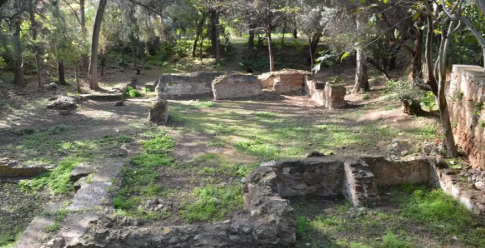
At the first location, within the grove, immediately north of Drakontos Street, under a protective shelter, stands the Geometric-period (c. 700 BC) “Sacred House,” built of unbaked mudbricks, as well as a second, prehistoric dwelling of the Early Helladic period (c. 2500 BC) with an apsidal plan. These two structures are remains of the sparse habitation of the area before the establishment of the Gymnasium. Nearby, a long wall with buttresses was uncovered (now reburied), identified with the so-called “Hipparchos wall” mentioned in ancient sources, that is, the enclosure of the grove. Sections of enclosures have also been found in other areas, along with stone boundary markers inscribed “horos tēs Akademias” (boundary of the Academy).
2. The Gymnasium
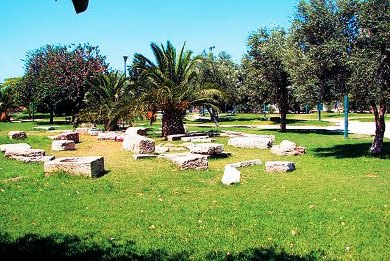
At the second location, within the grove, between its main entrance (at Kratylou and Tripoleos streets) and the church of Agios Tryfon, part of the Gymnasium has been revealed. Visible remains include sections of the large rectangular courtyard of its Palaestra, surrounded by elongated enclosed rooms. To the north, a reservoir served the bath facilities of the athletes. This building is generally dated to the 1st century BC–1st century AD. According to another interpretation, the rooms in its northern section may have been the library of Plato’s School. On either side, remains of Roman-period buildings have also been found, clearly associated with the athletic and educational functions of the site.
3. The Square Peristyle
At the third location, at the junction of Platonos and Evkleidou streets, lies the partially preserved “Square Peristyle” (4th or 3rd century BC), measuring 40 × 40 m. The architectural form and function of this building are not entirely clear. One interpretation suggests that it may have been the actual Palaestra of the Gymnasium. Clay painted metopes from the 6th century BC found here testify to the existence of an earlier public building on the site.