


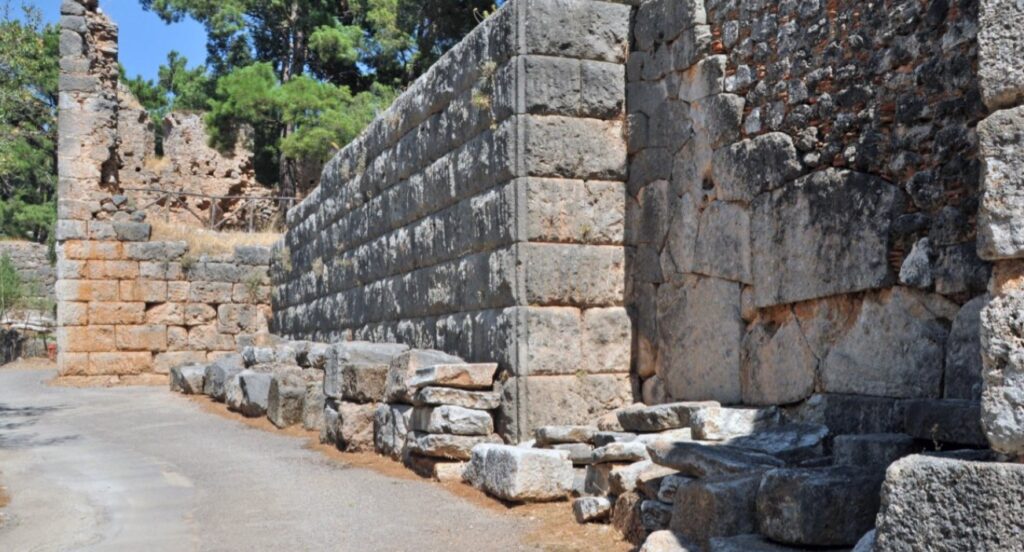



Amfissa, the most important city of the Western Locrians, flourished thanks to its strategic location and reached its greatest prosperity during the Classical, Hellenistic and Early Roman periods. The city owes its name to the nymph Amfissa, daughter of the mythical king Makar, son of Aeolus. The city's turbulent history is reflected in its fortified acropolis and defensive walls, which formed the core of the ancient city's defense system. Amfissa has been inhabited since the Geometric period and played an important role in ancient Greek history, participating in wars and conflicts. Its most significant event was its destruction by Philip II of Macedon in 338 BC, after which it was rebuilt and continued to prosper. During the Frankish period, Amfissa became the seat of a barony and was known as La Sole. This medieval name later evolved into Salona, the name by which the city was known throughout the Ottoman period and into modern times. The archaeological site of Amfissa includes the remains of the ancient city and its fortified enclosure. Among its best-preserved monuments are the city walls. Sections of both ashlar and polygonal masonry, dating to before the destruction of 338 BC, are still visible today. Ancient building material scattered after the city's destruction was incorporated into the walls during their medieval reconstruction. Today, extensive sections of the medieval fortifications can still be distinguished, built with rectangular ancient stones bonded with mortar and smaller stones. The most important finds from the excavations of ancient Amfissa are now exhibited at the Archaeological Museum of Amfissa.
http://odysseus.culture.gr/ Συντάκτης Α. Τσαρούχα, Αρχαιολόγος

