







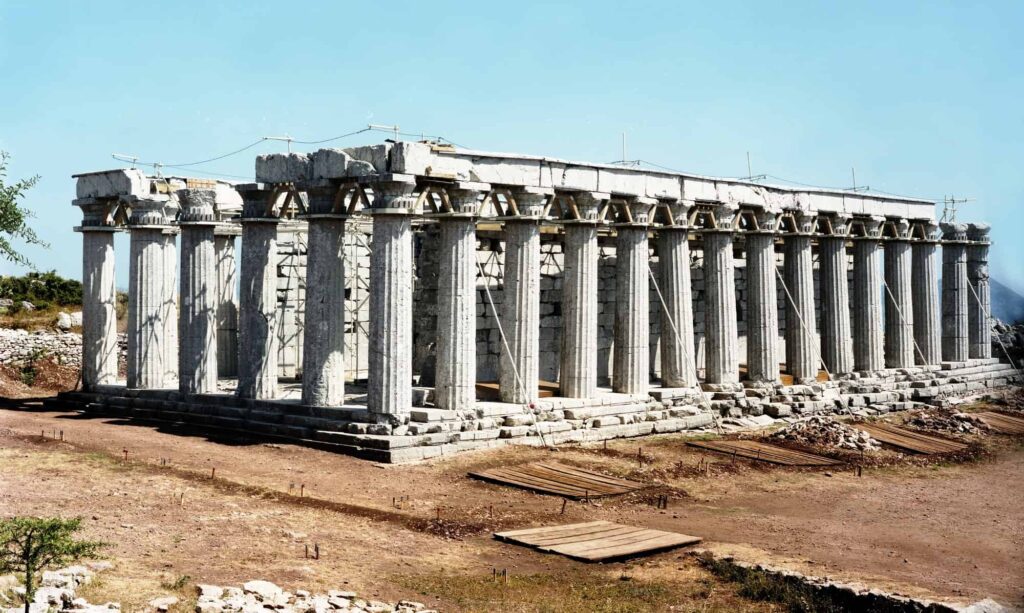
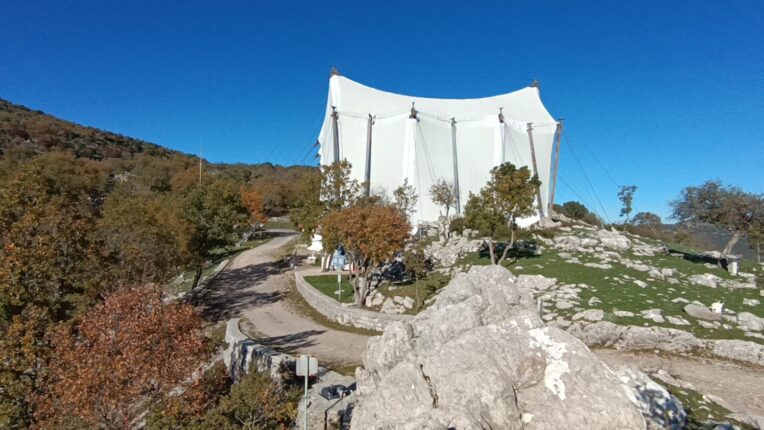


Bassae is located in a mountainous area at the borders of Arcadia, Triphylia, and Messenia, near Figaleia, and owes its name to the small valleys of the terrain. There, the people of Figaleia founded a sanctuary dedicated to Apollo, who was worshipped as “Epicurius,” either as a protector in warfare or as a savior from epidemics.
In the wider region, Artemis, Aphrodite, and Demeter were also worshipped. The sanctuary of Apollo continued to function during Hellenistic and Roman times but was later abandoned and damaged by earthquakes.
The Temple of Epicurian Apollo at Bassae is one of the most important and original monuments of ancient Greek architecture, built around 420–400 BC and attributed to the architect Ictinus. It stands out for its unique combination of archaic and classical elements and for the use of all three architectural orders: Doric, Ionic, and Corinthian.
The temple has an unusual north–south orientation and an elongated plan (6x15 columns), differing from the standard form of the period. It is built mainly of local limestone, with marble elements in selected parts, and includes a pronaos, cella, adyton, and opisthodomos. Inside the cella, Ionic half-columns form niches, while the central column bears the oldest known Corinthian capital.
The adyton likely housed the cult statue of Apollo, and a rare side entrance is also present. Externally, the temple featured a Doric frieze, while inside it had a magnificent Ionic frieze 31 meters long, consisting of 23 marble slabs depicting Amazonomachy and Centauromachy.
Attributed possibly to the sculptor Paionios, the frieze is now in the British Museum, transferred there after its excavation in 1812 and removal in 1815. Overall, the temple combines technical excellence, artistic innovation, and religious symbolism.
http://odysseus.culture.gr/ Συντάκτης Ολυμπία Βικάτου, αρχαιολόγος
https://ilia-olympia.org

