







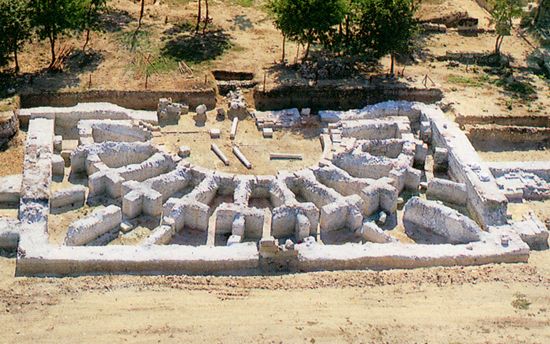
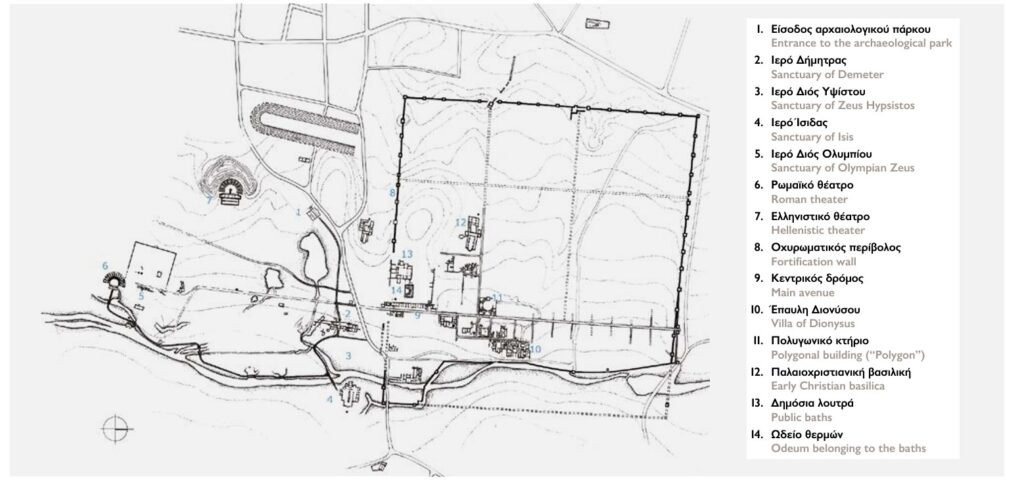


The Roman Theatre of Dion is located a short distance southeast of the Hellenistic theatre, outside the boundaries of the city. It dates back to the 2nd century AD and probably replaced the earlier theatre, which appears to have been functioning only partially after 168 BC. It was built on level ground, facing east, and was smaller in size than the Hellenistic theatre. Similar in form to the corresponding theatres of Corinth and Patras, it included a cavea with a radius of 16.45 m, an orchestra with a diameter of 10.70 m, a stage building and a proscenium. The cavea, divided into four sections by three narrow stairways, was externally defined by a high semicircular masonry wall. The seating rows rested on the roofs of eleven wedge-shaped, vaulted spaces arranged radially. Apart from the two outer spaces, which communicated with the side entrances (parodoi), these areas were open towards the semicircular corridor that ran internally along the outer wall. The theatre must have had 24 rows of seats, of which only a few survive today. The stage building was independent from the cavea and was richly decorated with valuable marble revetment and sculptural decoration; unfortunately, however, most of it was destroyed by rising underground waters. At least four areas of the cavea and the stage building underwent modifications, dated to the last quarter of the 4th century AD, based on coins discovered during the excavation. These interventions may have been caused by the collapse of parts of the theatre due to earthquakes or by a partial change in its use.
http://odysseus.culture.gr/
https://www.dion-olympos.gr/ www.odap.gr 098_DION_PIERIA
https://digitalculture.gov.gr/
https://diazoma.gr/

