







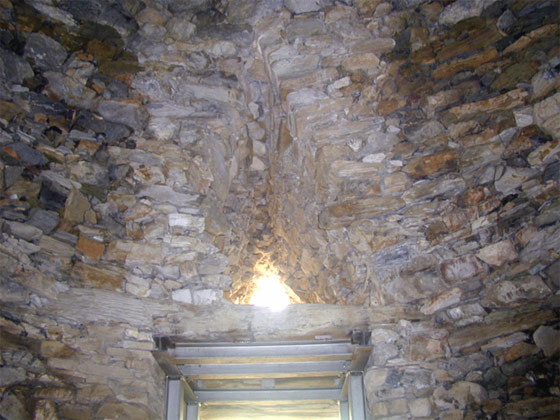


The smaller and earlier of the two important Mycenaean tholos tombs discovered at Dimini is the so-called "Lamiospito". It is situated 300 metres west of the hill where the remains of the Neolithic settlement are located, built into a sloping hillside. Based on its architectural form, it is dated to the 14th century BC (Late Helladic IIIA2 period).
Access to the tomb was provided through a slightly descending dromos (entrance passage), measuring 14.50 m in length and 3.30 m in width. The sides of the dromos are supported by stone-built retaining walls, each 1 m thick, which converge slightly towards the entrance of the tomb and reach a height of 5.70 m where they meet the tholos. Following each burial, the end of the dromos was sealed with a stone-built blocking wall 2.00 m thick.
Entrance into the burial chamber was through the stomion (entrance passage), measuring 3 m in height, 2.20 m in length and 1.90 m in width. It is roofed by four large stone slabs forming its lintel, above which was the relieving triangle.
The tholos chamber, with a diameter of 8.20 m and a height of 8.10 m, was constructed using the corbelled vaulting technique, probably with the aid of wooden formwork, although no traces of it survive. It was built of small, irregular limestone blocks laid without mortar, with particularly strong reinforcement at the base. The floor was formed by levelling the natural limestone bedrock.
The upper part of the tholos was sealed by a large circular capstone, known as the "keystone."
Although the tomb yielded relatively few finds, they are of exceptional importance. They include mainly glass jewellery, ivory objects and bronze weapons, all of which were transferred to and are now exhibited in the National Archaeological Museum of Athens.
During the Roman period, a lime kiln was constructed on top of the burial mound, directly against the masonry of the tholos. It was built to supply lime for the construction and maintenance of the Roman aqueduct that carried water to the ancient city of Demetrias.
http://odysseus.culture.gr/Συντάκτης Στ. Αλεξάνδρου, αρχαιολόγος
https://www.arxaiologikoktimatologio.gov.gr/

