







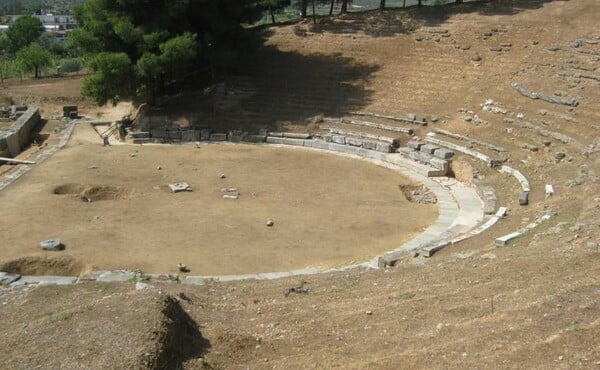


The theatre of Demetrias was constructed at the same time as the foundation of the city (294–292 BC) by the Macedonian king Demetrius Poliorcetes. For a long period, the theatre fell into disuse due to damages it suffered (from the last two decades of the 2nd century BC until 79 AD). After a major restoration, it continued to operate until its final abandonment in the 4th century AD, when, with the emergence of new socio-political structures in the city, the theatre ceased to host public events. The theatre of Demetrias has all the basic characteristics of Hellenistic theatres, namely the cavea, the orchestra, and the stage building. The Hellenistic cylindrical altar with bucrania and garlands was located in the center of the orchestra. The theatre, apart from being a place of performances, was also a site for the publication of decrees and texts of public political acts. Around the orchestra of the theatre, marble stelae with decrees of Demetrias and the Koinon of the Magnesians were erected, such as the large honorary decree of the Koinon of the Magnesians issued to honor the Secretary of the Synedroi of the Koinon, Demetrios son of Orestes.
http://odysseus.culture.gr/Συντάκτης Π. Τριανταφυλλοπούλου, αρχαιολόγος

