







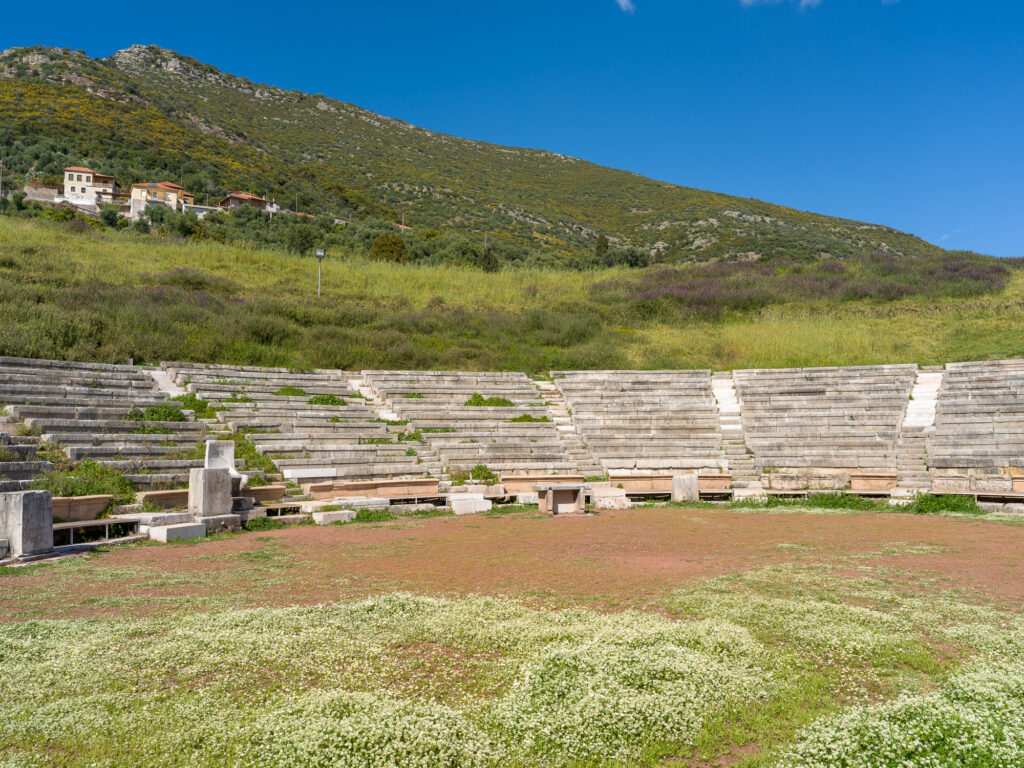


The Theatre of Messene, which is only indirectly mentioned by Pausanias (4.32.6), was uncovered northwest of the Sanctuary of Asclepius and 50 m west of the Agora. It was constructed in the 3rd–2nd century BC and is one of the largest theatres of antiquity. Its width reaches 98.60 m, while the diameter of its orchestra is 23.46 m. It was used for the entertainment of citizens, but also for gatherings of a political nature, as evidenced by the epigraphic finds. During the Roman Imperial period (1st–2nd century AD), it acquired its present form after radical alterations were made to the auditorium and the stage building of the Hellenistic period. The extensive destruction of the auditorium is mainly due to the inhabitants of the settlement of the Early Byzantine and Byzantine periods, who transformed the theatre into a “quarry”, extracting building material for the needs both of the settlement and of the nearby Basilica. The auditorium of the Theatre rests on an artificial fill, which is retained by a strong semicircular retaining wall, the western section of which is preserved in good condition. The retaining wall, built of massive stone blocks, has the same form as the city’s fortifications, gates and towers, and approximately every 20 metres it featured impressive pointed gateways with internal staircases leading to the upper diazoma. From there, descending stairways began, ending at the orchestra and defining the seating sections of the structure. A large external stone staircase on the northwestern curve of the retaining wall leads to the upper diazoma, emphasizing the architectural particularities of the monument.
http://odysseus.culture.gr/ Συντάκτης Γεωργία Χατζή – Σπηλιοπούλου, αρχαιολόγος https://www.efamess.gr/pois/theatro-archaias-messinis/

