







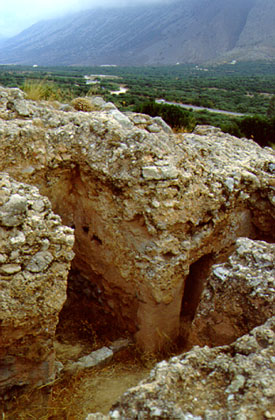


The settlement of Vasiliki, one of the earliest Minoan settlements with urban planning, occupies the slopes and the summit of a low hill near the village of Vasiliki, very close to the Minoan settlement of Gournia. It began in the Early Minoan II period (2600–2300 BC) and flourished not only due to its strategic position along the passage of the Isthmus of Ierapetra, but also because of the fertile plain of the region. The central building of the settlement was destroyed by fire around 2300 BC. However, the hill was reoccupied later, with a Middle Minoan building (2200–1900 BC) and traces of habitation from Roman times having been uncovered. The most important monuments and architectural complexes of the Minoan settlement of Vasiliki include the so-called “House on the Hill.” This is a very large structure, considered a precursor—on a smaller scale—of later Minoan palaces. Its four corners are oriented to the cardinal directions, suggesting influences from Eastern architecture. The rooms are rectangular and connected by long corridors. The southern wing is the largest. Some of the elongated rooms were used as storage spaces, others as private living quarters, and there is also a paved courtyard with a skylight or rock-cut channel. The interior surfaces were coated with red plaster, while the walls were reinforced with wooden beams. The ground floor walls were built with small stones and clay mixed with straw, while the upper floor was made of mudbricks. House A of the Middle Minoan period, located at the junction of two roads with a narrow entrance from the stepped path, is a characteristic example of Minoan houses, where rooms were added according to needs, though with a certain architectural order. The settlement appears to have had four main construction phases, each with remains of houses from the respective period. Especially in the Middle Minoan period, houses likely covered the entire eastern slope of the hill.
http://odysseus.culture.gr/

