






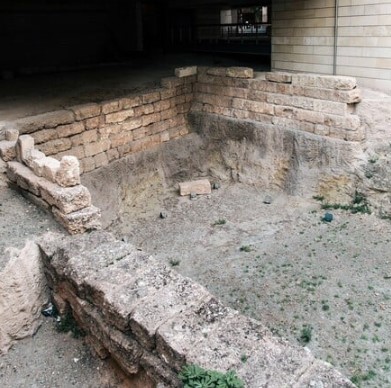


During the conversion of Aiolou Street into a pedestrian precinct in 2003, archaeological excavations revealed part of the city's ancient fortification, which had been partly excavated in 1973-1974 and is now preserved on the corner of Aiolou and Sofokleous Streets, in a land plot owned by the National Bank of Greece. All of the fortification's constituent parts were uncovered: the main wall (teichos), the internal perimeter road, the outer wall (proteichisma), the moat with its retaining wall, and the external perimeter road. Of the main wall, only a single course of limestone blocks from its north face is preserved over 1.08 metres, the south face and fill having been destroyed by the construction of the dense public utilities network. The wall was founded on bedrock (schist). A 3.50 metre stretch of the 3.10-metre-wide internal perimeter road was identified north of the main wall. Ten successive street layers are preserved, although cut through by intermittent shafts and a circular well. Two Roman terracotta conduits and a pillaged grave were excavated along the road. The outer wall lay just beneath the surface of Aiolou Street, 3.10 metres north of the main wall and over a distance of 3.28 metres. It preserves five courses made of large blocks founded on bedrock (schist). A retaining wall of large conglomerate blocks lined the moat, which was cut through by later constructions, including a paved rectangular reservoir with built-in staircase of the Late Roman period and a terracotta conduit. The moat's retaining wall also defines the south side of the external perimeter road, which was identified north of the moat. This road is 2.37 metres wide and only two street layers are preserved above the bedrock. Its north retaining wall was not recovered. The site was organized during the works for the Unification of the Archaeological Sites of Athens Programme. All of the constituent elements of the ancient fortifications were preserved in situ under three glass pyramids. The first pyramid (the one closest to Sofokleous Street) shelters the main wall's north face and the internal perimeter road with its ten street layers. The second pyramid shelters the five surviving courses of the outer wall and part of the moat, where the remains of workshops, including a rectangular basin, and a terracotta conduit were discovered. The third pyramid shelters the remaining part of the moat and its strong retaining wall, together with part of the external perimeter road.
ΠΗΓΗ:http://odysseus.culture.gr/ Συντάκτης Ε. Όλγα Ζαχαριάδου, αρχαιολόγος

