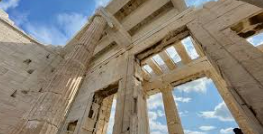
The pi-shaped building of Pentelic marble frames beautifully the entrance to the sacred precinct. The central section, the on proper, had an outer (west) and inner (east) fa?ade, both supported by six Doric columns, and between them a wall with five doors. Three Ionic columns flanked the main, middle door on either side. The central section followed the configuration of the terrain so the east portico and its crowning pediment were placed higher than those to the west. The two lateral sections, too, were placed lower than the central one. The sloping terrain dictated the creation of flights of steps both inside and in front of the on. The north wing of the aia is described by Pausanias (1, 22, 6) as the Pinakotheke, an art gallery with paintings by famous artists, such as Polygnotos and Aglaophon. It has a fa?ade of three Doric columns and a door flanked by windows. Some scholars believe that this space was used as a refectory or resting area for the visitors to the Acropolis and that it contained beds. Like the north wing, the south wing has a fa?ade of three Doric columns but no back or side rooms because of its close proximity to the existing temple of Athena Nike. Access to this temple was possible through the south wing. In Christian times both the south wing and the central section of the aia were converted into churches, the former during the Early Christian period (fourth-seventh centuries AD) and the latter in the tenth century AD when in was dedicated to the Taxiarches. Under Frankish rule (thirteenth-fourteenth centuries AD) the aia became the residence of the dukes of de la Roche; during the same period a tower, known as Koulas, now demolished, was built against the south wing. In the Ottoman period (1458-1830) the aia were used as garrison headquarters and munitions store, resulting in a great explosion that destroyed the building in 1640. After the Greek War of Independence the Medieval and Turkish additions to the aia were demolished and the site excavated. Restoration work was undertaken by engineer Nikolaos Balanos in 1909-1917 and is again in progress since 1982, as part of the greater conservation and restoration project carried out on the Acropolis since 1975 by the Restoration Service of the Monuments of the Acropolis in collaboration with the First Ephorate of Prehistoric and Classical Antiquities, under the supervision of the Committee for the Conservation of the Monuments of the Acropolis.