






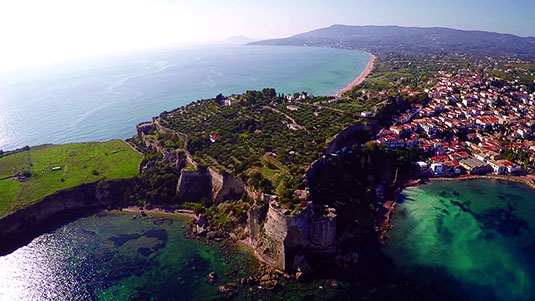


It is one of the most famous castles in Greece, located on the southeastern coast of the Prefecture of Messenia. It is built on a low peninsula-hill within the town of Koroni, which bears the same name. The castle was built during the Byzantine period, although the exact date is unknown, occupying the strategic geographical position where, according to Pausanias, the city of ancient Asine once dominated the area. The castle underwent successive building phases during the First Venetian Occupation (13th–15th centuries), including the addition of a large outer enclosure on the eastern side, strong fortification walls and a double semicircular bastion at the northeastern corner, providing protection from the sea side. During the First Ottoman Occupation (1500–1685), the fortifications of the castle were strengthened on the southeastern side with a second defensive line and the addition of two circular bastions at its ends. (The bastion at the northern end of the wall was blown up by the Germans at the end of the Second World War, and only a few ruins of it survive.) At the westernmost end of the castle, the Venetians built a bastion in 1463, which underwent successive building phases, the latest dating to the Second Venetian Occupation (1685–1715). Today, only part of it is preserved. Inside the castle dominate the ruins of a three-aisled basilica (possibly dating to the 7th century, with later additions), remains of the church of Agia Sophia. Nearby stands the present-day church of Agios Charalambos, which was originally built as a Catholic church dedicated to Saint Roch, later converted into an Ottoman mosque, and subsequently, in modern times, transformed into an Orthodox church. The western enclosure of the castle is occupied by the Monastery of the Holy Forerunner (Timios Prodromos), a Old Calendarist monastery founded at the beginning of the 20th century.
http://odysseus.culture.gr/ https://www.efamess.gr/

