

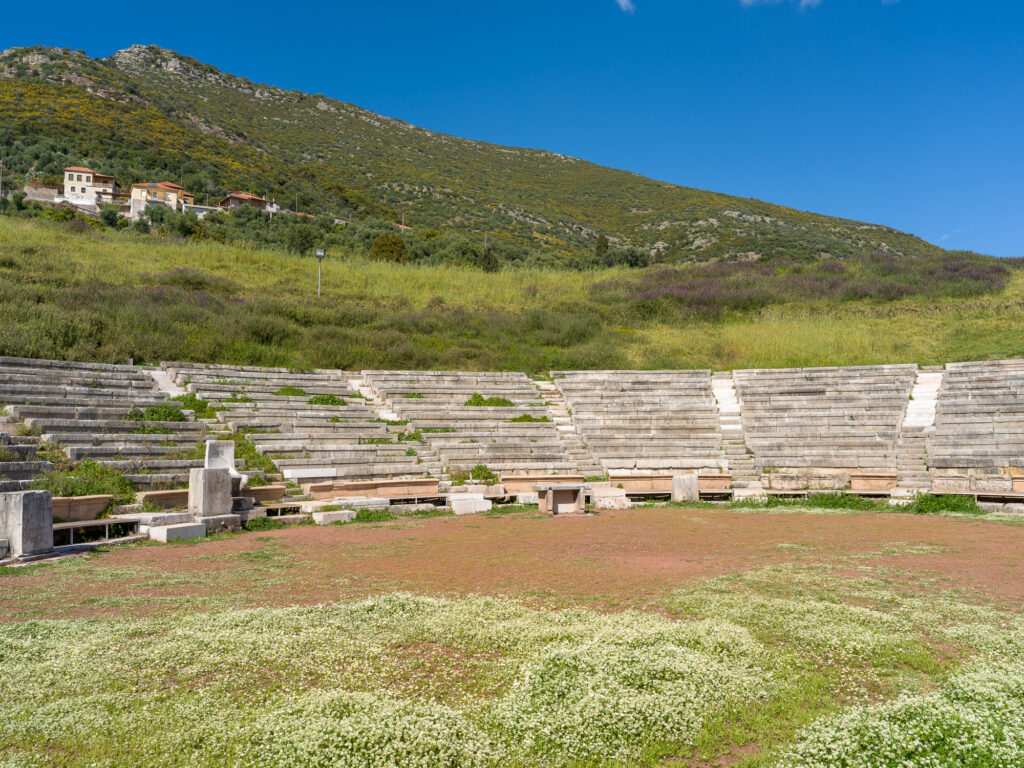

Ancient Messene Theatre, Messenia
No data
Category
Archaeological site
Location
Messinia
Keyword
ΜΕΣΣΗΝΙΑ
Rating
0/5
Vatika Castle is first mentioned in the Chronicle of the Morea, which records the granting of the area by William II Villehardouin to the nobles of Monemvasia. In 1262, the region came under Byzantine rule and later alternated between Venetian and Ottoman control until the outbreak of the Greek War of Independence in 1821.

The Theatre of Messene, which is only indirectly mentioned by Pausanias (4.32.6), was uncovered northwest of the Sanctuary of Asclepius and 50 m west of the Agora. It was constructed in the 3rd–2nd century BC and is one of the largest theatres of antiquity. Its width reaches 98.60 m, while the diameter of its orchestra is 23.46 m. It was used for the entertainment of citizens, but also for gatherings of a political nature, as evidenced by the epigraphic finds. During the Roman Imperial period (1st–2nd century AD), it acquired its present form after radical alterations were made to the auditorium and the stage building of the Hellenistic period. The extensive destruction of the auditorium is mainly due to the inhabitants of the settlement of the Early Byzantine and Byzantine periods, who transformed the theatre into a “quarry”, extracting building material for the needs both of the settlement and of the nearby Basilica. The auditorium of the Theatre rests on an artificial fill, which is retained by a strong semicircular retaining wall, the western section of which is preserved in good condition. The retaining wall, built of massive stone blocks, has the same form as the city’s fortifications, gates and towers, and approximately every 20 metres it featured impressive pointed gateways with internal staircases leading to the upper diazoma. From there, descending stairways began, ending at the orchestra and defining the seating sections of the structure. A large external stone staircase on the northwestern curve of the retaining wall leads to the upper diazoma, emphasizing the architectural particularities of the monument.

 http://odysseus.culture.gr/ Συντάκτης Γεωργία Χατζή – Σπηλιοπούλου, αρχαιολόγος https://www.efamess.gr/pois/theatro-archaias-messinis/

Amenities
e-ticket
Free Parking
Printed Museum Guide
Restaurant & Coffee
Shop
WC
FAQ
During the reigns of the Roman emperors Augustus and Tiberius (1st century AD), the stage building and the proscenium were completely replaced from their foundations. New repairs and modifications were carried out through the financial sponsorship of the powerful Messenian family of the Saethidae, around the middle of the 2nd century AD. The Roman stage building is preserved in a relatively good condition. Its façade was constructed as a multi-storey structure (at least three storeys high), with doors, arches and niches. White and polychrome, unfluted columns made of marble as well as granite were used for this purpose. The colonnade of the lower row was crowned with Corinthian capitals, while Ionic and Egyptianising capitals were placed on the upper levels. These elements of the Theatre of Messene foreshadow the colossal theatres and amphitheatres of the Roman period. The ground-floor section of the stage building consists of a central semicircular niche and two rectangular ones, located to its right and left. Each niche contained two bases for the erection of six marble statues in total, depicting benefactors and other persons. Statues were placed in the smaller niches of the upper storeys of the stage building, while statues of intellectual figures and benefactors had also been erected around the orchestra of the structure. The Theatre of Messene appears to have been abandoned already at the end of the 3rd or the beginning of the 4th century AD. This conclusion is based on the use of stone blocks from the retaining wall of the auditorium during the final construction phase of the Arsinoe Fountain, which dates to the reign of Diocletian (284–305 AD).
Review
0
0 Review
Be the first to write a review.
Working Hour
  • Closed Now
    UTC+009:00 AM - 06:00 PM
  • Monday
    09:00 AM - 06:00 PM
  • Tuesday
    09:00 AM - 06:00 PM
  • Wednesday
    09:00 AM - 06:00 PM
  • Thursday
    09:00 AM - 06:00 PM
  • Friday
    09:00 AM - 06:00 PM
  • Saturday
    09:00 AM - 06:00 PM
  • Sunday
    09:00 AM - 06:00 PM
Detail info
Keyword
ΜΕΣΣΗΝΙΑ
Location
Μαυρομάτι, Δήμος Μεσσήνης Μεσσηνίας
Map
Featured Listing

All Chat Users

    Start Chat

    Select a listing or user to start your chat.

    Browse Users

    Chat Settings

    Chat Theme
    0/50
    Set a greeting message to show to new chat participants. E.g., Welcome to my chat.
    0/50
    Set a fixed notification for the chat owner. E.g., We are off for this month.
    No images found.
    Compare Listings